

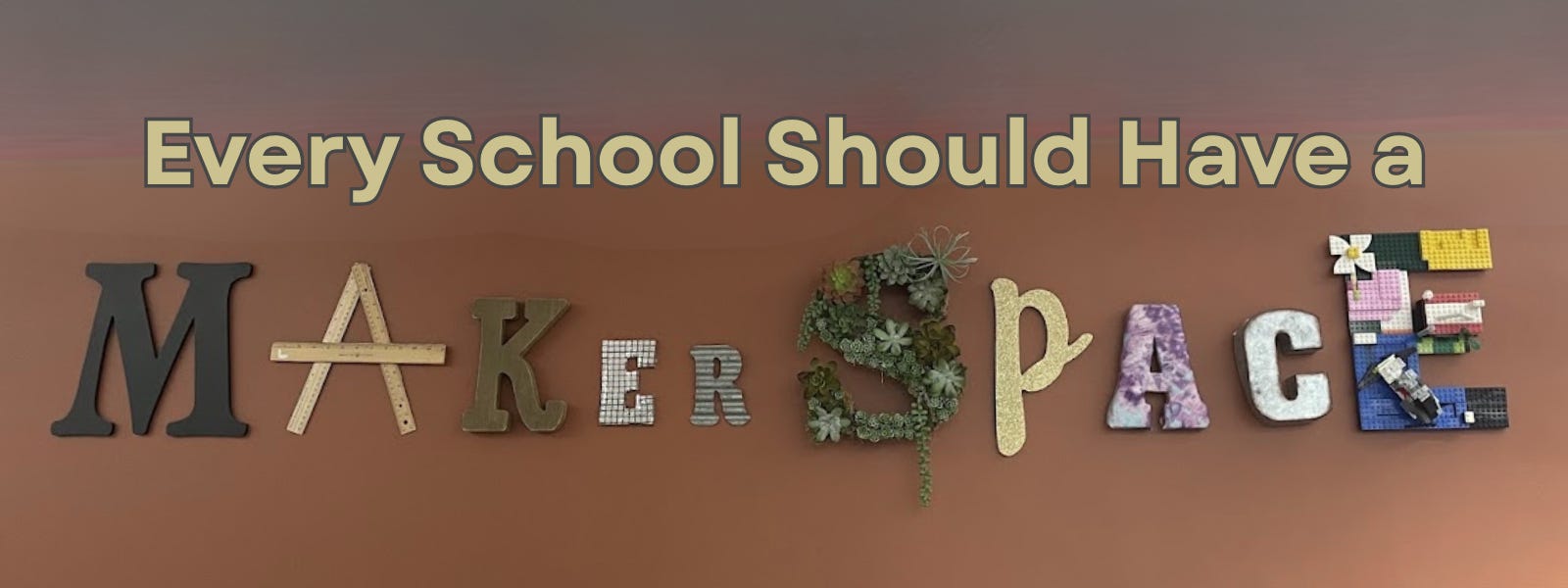
Every School Should Have a Maker Space
(and why mine is AMAZING!)
Last week in my Holocaust and Human Behavior course, my students worked on their final project: a symbolic toolbox for justice.
The assignment asks them to think metaphorically about what a person needs in order to confront injustice in the world. Each student chooses an overarching symbol and then builds a collection of tools that represent ideas such as courage, inquiry, compassion, resistance, truth, and responsibility. The twist is that the toolbox must exist in three dimensions.
They actually have to make it. The real rigor, however, does not come from the glue gun. Each tool must be justified in writing, and students must connect their ideas to historical examples we studied this term. They draw from the Ottoman Empire, World War I, the Weimar Republic, the Holocaust, the Russian–Nazi nonaggression pact, the U.S. rejection of Jewish refugees, the White Rose leaflets, the USS St. Louis, the Warsaw Ghetto Uprising, and dozens of other moments in human history when ordinary people faced extraordinary moral choices. In other words, the tools cannot just look meaningful. They have to be meaningful.
I wish I could say I created this assignment myself, but the credit belongs to my friend Sheila Morton and the brilliant curriculum team at Facing History and Ourselves, who designed and refined this project for high school students. What I can claim is the privilege of watching it unfold: a literal toolbox, a suitcase full of letters, a toybox full of objects that bring comfort and inspiration. One student built a battered first aid kit filled with symbolic remedies for a sick society. Another student created a small garden, which was particularly close to my heart, using the language of flowers to represent the ways we bring beauty and life back into a broken world. Each plant symbolized something different: courage, compassion, truth, perseverance. Instead of tools made of steel, this student imagined tools that grow.
Then one of my boys built a sandwich. It was a full three dimensional model, layered carefully with ingredients meant to nourish justice in everyday life. I could not help laughing when I first saw it because it was so perfectly on brand for this particular student. For four years he has appeared in my classroom asking the same hopeful question.
“Do you have any snacks in your cabinet?”
He has taken AVID with me, English with me, served as a teacher’s aide, and now sits in my Holocaust and Human Behavior class. Needless to say, this student knows exactly where the M&Ms are stashed in my file cabinet.
But the more he explained his project, the more I realized how thoughtful it really was. His writing described bread as one of the most universal foods in the world, something shared across cultures, religions, and generations. Bread shows up everywhere in human history, including in many of the stories and documents we studied this term. It feeds people in ordinary times, and it becomes even more meaningful during moments of scarcity, displacement, and crisis.
He wrote that justice, like food, has to nourish people if it is going to last. One of the threads running through our historical case studies is the tension between courage and fear. Some people act. Others freeze. Some nourish humanity. Others allow it to starve. In his metaphor, the ingredients of the sandwich represented the qualities that help societies choose courage instead of paralysis. It was almost poetic. A kid who spent most of his high school years looking for Ritz peanut butter crackers and Jolly Ranchers ended up creating a project about feeding justice in the world.
Watching these projects come together over the course of the week was remarkable. Students debated what kindness actually looks like when it costs you something. They wrestled with the difference between compliance and courage. They talked about propaganda, bystanders, and the fragile courage it takes to stand against injustice. Some of those conversations happened around desks during the term as they wrestled with maybe some of the toughest questions of humanity.
At the end of the term when we have done all of the talking and thinking that time allowed, they got to pick and choose what was important to them and have one final sets of conversations about the values and tools they will carry into their futures to make this world a more just place. Many of them happened while students were cutting cardboard, painting symbols, and trying to figure out how to make their ideas stand up in three dimensional form.
Which brings me to maker spaces.
If you are not familiar with the term, a maker space is exactly what it sounds like. It is a place where students can build, experiment, create, and tinker. Sometimes these spaces include high tech equipment like 3D printers or laser cutters. Sometimes they include cardboard, glue, tape, and the kinds of supplies that normally send parents racing to Walmart at 10:30 at night the evening before a science fair project is due.
The tools matter less than the environment. A maker space gives students permission to think with their hands. That matters more than people realize because traditional school projects often rely heavily on what happens outside of school hours. A teacher assigns a creative project and assumes that the materials, time, and support will somehow appear at home. That is a lot of assuming.
Some parents look at the assignment and immediately see the price tag. Poster board, glue, paint, markers, craft supplies. It adds up quickly. When a family cannot afford it, they do not quietly go buy the materials anyway. Instead, the parent tells the student to take the issue up with the teacher. The student always walks into class empty handed and angry, not really sure why they are willing to die on the hill that it was a “lame project” and they wouldn’t do it any way. As adults we see how we’ve put the kid in an impossible position, but the demands don’t change. All we do is communicate that because the child doesn’t have access to the assignment, they are somehow deficient.
Other families may want to help, but the time simply is not there. Parents are working long shifts. A grandparent is watching younger siblings. Life is complicated. The writing may get finished, but the project never quite comes together. These kids learn to make excuses and apologize profusely and the lesson here is that you probably will never be able to live up to your potential.
Then there are the last minute emergencies. A student waits until the night before, because…teenagers procrastinate. Sometimes because they know the resources were never really there to begin with so they just wait until the last minute hoping that some miracle will come into their lives. Then at 10:30 on the night before it’s due, suddenly everyone is scrambling. Supplies are purchased in a rush or a parent stays up half the night helping their child assemble something presentable. Somewhere around 2:00 am, the parent sends the child to bed and the kid brings in the half finished project, or occasionally the parent just finishes it themselves to prevent their kid from feeling like a failure.
Teachers recognize these patterns because we see them every year. And for those of us who are parents too, we have lived this scenario enough times to cringe when the project paper comes home in our kids’ backpacks. The truth is that this dynamic is a shared problem between schools and families. Teachers expect, or at least quietly assume, that parents will step in and help make these projects happen. When the project does not appear, the frustration often lands squarely on the student. The shame gets heaped on kids who are, at the end of the day, still kids.
You would think the problem would become less as kids get older, but even high school students do not have unlimited autonomy. They cannot drive themselves to the store. They cannot pull out a credit card to buy supplies. They cannot always rearrange the realities of their home life to complete a project that depends entirely on what happens after school.
Nor should they have to. Projects that rely entirely on home environments quietly reward students with the most resources and support while putting others at an immediate disadvantage.
Maker spaces change that equation. When the materials are at school, the financial burden disappears. Students can work during the day. They have time to experiment, revise, and ask questions.
And the benefits go far beyond access to supplies. When students work in a maker space, they are learning inside what educators call a socially constructed learning environment. Students are not thinking in isolation. They are building ideas together.
The thinking gets deeper. A student working alone can only work with the ideas they already have. A student sitting at a table with ten peers suddenly has access to ten different ways of seeing the same problem. Ideas bounce around like sparks. Students rethink, revise, and refine their work in real time. They begin paying attention not only to what they are creating, but how they are thinking.
Confidence begins to grow. Part of that confidence comes from the quiet community that forms in the in between moments. Maker space work naturally creates pauses. Someone is holding two pieces of cardboard together while the glue sets. Another student is waiting for paint to dry. Someone else is digging through a bin of ribbon looking for the right color.
And during those pauses, conversations happen. They are often about the real lives students are living outside of school. The ballgame on Thursday night. The dress someone just bought for prom. Why you should never work at the ice cream parlor because the pay is terrible and the manager makes you clean the machines every night.
It sounds off topic. It is not. Those conversations build community. When students feel comfortable with the people around them, they become far more willing to say things like, “I am not sure this idea works,” or “Does this make sense?” or “What if I tried it this way?” The risk of being wrong starts to feel smaller because the room feels safe.
Our high school is fortunate enough to have a space where this kind of learning thrives, and the person responsible for it is our librarian, Caramia Milloway. If you have ever met a librarian who truly sees kids, you know the difference immediately. Caramia understands that a library should not feel like a museum where books sit quietly on shelves and students tiptoe around as if they might break something.
Our library is exactly the opposite. Students want to be there. They come before school. They show up during lunch. They ask if they can go to the library during my class to check out books. Instead of organizing everything strictly through the Dewey Decimal system, Caramia arranges books more like a bookstore. Students browse by topic and interest, wandering through their favorite genres the way readers do in places that invite curiosity rather than enforce silence.
In the middle of all of this are small maker stations scattered throughout the library. There are giant collaborative coloring posters stretched across tables. Chess boards sit mid match between students who have been playing the same game for days. There are puzzles, intricate building sets, and other quiet ways for students to keep their minds engaged while letting their brains downshift for a moment.
And something important happens in those spaces that schools often underestimate. Schools do not have many places where students can simply build community together outside of the lunchroom. When students sit down to work on a puzzle together, they are not just working on the puzzle. They are cooperating. They are talking. They are connecting on the down low. One student might be searching for the green leaf piece while another is trying to finish the corner that has been driving everyone crazy for weeks. The puzzle slowly grows over the course of a month as different students stop by and add a few pieces at a time.
Along the way, relationships and compassion form. It is surprisingly difficult to start a fight with someone you spent thirty minutes helping find the last piece of a corner. It is harder to spread a nasty rumor about someone when the two of you just worked side by side picking out the perfect colors to finish the poster of a mountain scene. The work itself is simple. The community it builds is powerful.
Just off the main library is the room where that spirit of creativity expands even further. That room is our maker space. In the center sits a huge conference table that can seat twenty students comfortably. Around the perimeter is a wraparound counter that can hold another thirty. The walls are lined with shelves that look like the supply aisle of every last minute science fair emergency purchase ever made. Cardboard. Poster board. Ribbon. Paint. Scrapbook supplies. Scissors. Glue. Markers. Enough washi tape to make Hobby Lobby jealous.
And that is where my students built their toolboxes for justice. Instead of scrambling at home or arguing about supplies, they sat around those tables together. They talked. They asked questions. They tested ideas. They revised symbols. They helped each other figure out what their metaphors really meant.
The garden grew there. The toolbox filled up there. And yes, the sandwich got built there too. And at the end of the day, a sandwich just might be more than a sandwich. Ask my students.