

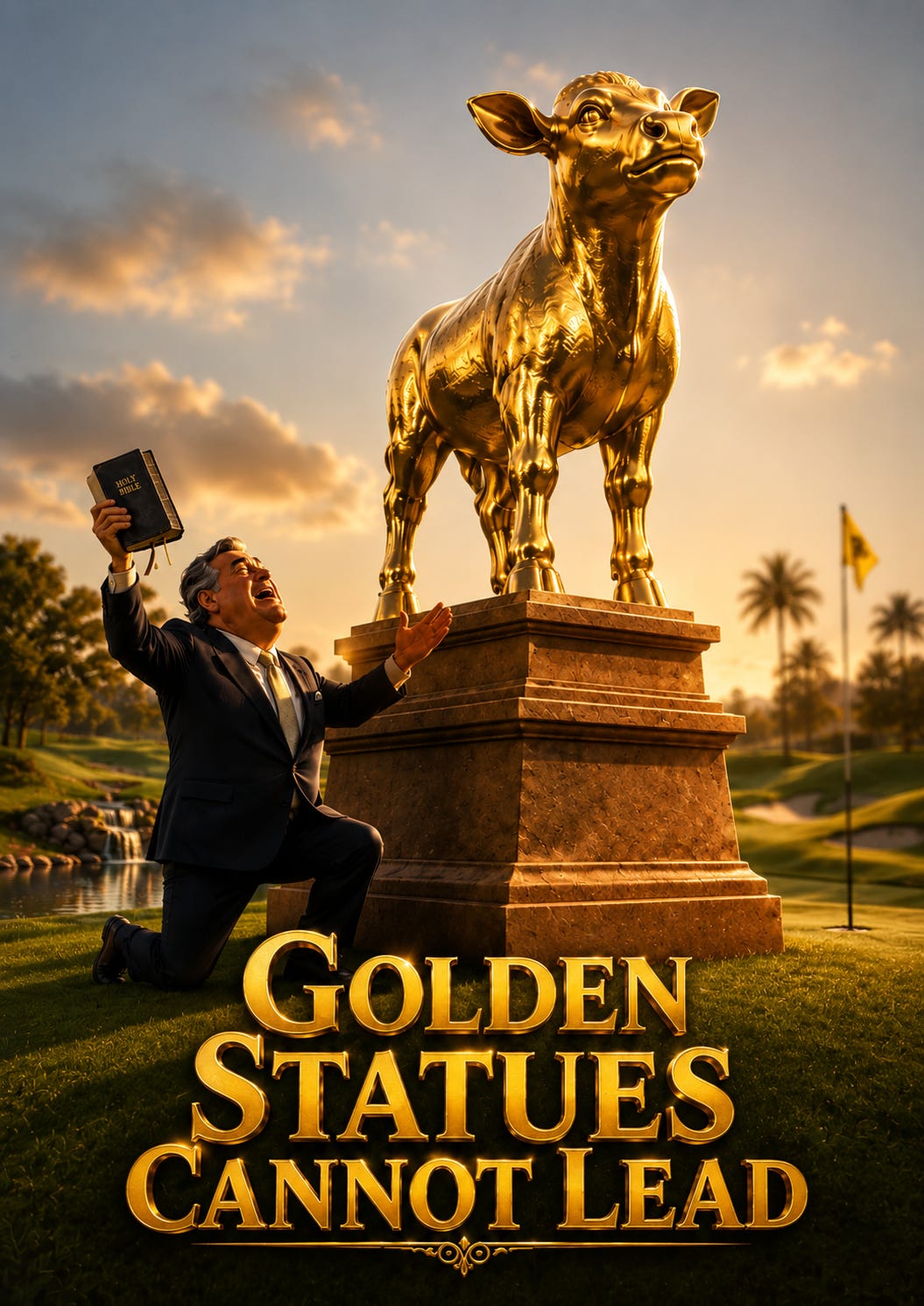
Golden Statues Cannot Lead
When frightened people melt their fear into something shiny and call it rescue
This weekend I was catching up on the news, and I saw a 22-foot gold-leafed bronze statue of Donald Trump. My gut response: oh, boy! More AI. But noooo…it was totally legit. Apparently that oversized version was named Don Colossus, and it is supposed to show Trump with his fist raised, echoing the image of him after the July 2024 assassination attempt. They put it on one of the Trump properties. My next thought was, who in the world would agree to make this thing, and please don’t tell me it was on the tax payer’s dime. The statue was sculpted by Alan Cottrill who has done quite a few other important pieces like a statue of Thomas Edison for the National Statuary Hall. Who paid for it? Hold your nose for this one. It was commissioned by cryptocurrency investors promoting the….wait for it…$PATRIOT coin. Apparently, they struggled make get the payment (which was $500,000 for this well known artist). So, he held onto it and told them there’s no installation until it is paid in full. I guess all of their money was stuck in the crypto-sphere?
The name Don Colossus made me snicker. The ancient Colossus of Rhodes was a massive statue of Helios, the sun god, built after the city survived a war, It is one of the Seven Wonders of the ancient world. (I know, I know, naming a gold-toned image of Trump Don Colossus does not mean everyone involved secretly worships the sun god, Helios, but can we just smile that this statue was on a golf course in Miami.) The original Colossus was huge, and the name in Trump’s likeness drags ancient religious and political symbolism to the golf course before anyone makes it to the first hole.
On the day of the unveiling, Trump wasn’t actually there. So, Pastor Mark Burns, a longtime Trump supporter, led the dedication ceremony, which was attended by religious MAGA allies. And, just for fun and giggles, it is probably interesting that Burns just so happens to be running for South Carolina’s 3rd Congressional District which feels just a little too convenient for some national “Jesus” press. Of course, Trump was giddy about the whole thing and praised the statue on Truth Social and said golfers at Doral “love” it.
I couldn’t help remembering the famous Old Testament story about the golden baby cow that’s found in Exodus. So, I went back to read it. There’s a lot of context to the story: the Israelites have escaped Egypt after the plagues and the Red Sea miracle (think Charlton Heston in “The Ten Commandments”). They arrive at Sinai roughly two months after liberation, and Moses goes up the mountain to meet with God. After the mountain is covered in smoke and thunder they are told not to touch the mountain because they will surely die.
So Moses becomes the mediator. He was the mediator with the Pharaoh, and so why not be the mediator with God. He is the only one who can go up the mountain and carry the people’s fear toward God and God’s words back to the people. Moses does this a couple of times where he comes down with the 10 commandments and a bunch of laws. The last time Moses goes up he is gone for forty days and forty nights.
While Moses is on the mountain, God gives him instructions for a way that the Israelites can have spiritual intimacy. The ark of the covenant, the mercy seat, the tabernacle, the priesthood, and the whole holy architecture of communion all point toward a God making a way to dwell among people who are still learning how to be free.
Meanwhile, down in the camp, the people are really afraid. I’ve often heard this story told like the people are insolent children who are impatient and badly behaved. But I don’t think this is people getting impatient because Moses is late. There are no cell phones with a text that says “running behind, be down by dinner”. Moses has gone into the mountain that the people believe they cannot approach directly without dying. From their perspective, Moses may be dead. God may have rejected them. They may be alone in the desert with no leader, an angry God and no hope for the future.
Aaron is standing inside that panic, and I am absolutely sure he doesn’t know what to do in this moment. I don’t think he’s thinking, “Excellent, today God left us high and dry, so let’s start a new bovine-based religion.” Israel’s faith had survived in the form of inherited memory, while Egypt had trained their daily imagination. Good grief! Americans cannot agree on our own history with written documents, photographs, court records, and museums, and we are barely 250 years into this national experiment. Israel had been formed by centuries of Egyptian power and had to learn, almost overnight, how to live as people claimed by the God of their ancestors.
Aaron gives frightened people what they ask for instead of what they need. He gives them a visible mediator. He gives them a baby cow that they make out of the most valuable things they carried with them as a way to feel connected again. He gives them, in the most ridiculous and painfully accurate phrase I can manage, a mooing telephone straight to God.
I often wondered what was the deal with making the statue a baby cow. It seems like such a useless symbol, but the calf was not random. The Apis religion in Egypt used a living bull that they saw as a link between people and the gods. When the bull died, the people chose a new calf after 40 days to be raised as the living embodiment of divine presence tied to strength, fertility, and life-giving power. Aaron was reaching for imagery the people already understood. Aaron did not invent a new religious language from scratch. He borrowed one that fear already knew how to read.
The Apis bull, strange as that whole system may seem to me, was at least alive. It had breath in its body. It had to be fed and tended. It could grow, age, die, and be mourned. Aaron’s calf was different. It was not a living creature with sacred meaning attached to it. It was gold forced into the shape of borrowed meaning. It had never breathed, never moved, never carried life in its body, and never had the ability to become anything more than what frightened people needed it to represent. The people asked for something that could go before them, and Aaron gave them a thing that had to be carried.
The people’s willingness to give their gold does not feel strange to me. They were afraid, and frightened people will sacrifice dearly for anything that promises restoration. Handing it over may have felt like devotion or maybe it was a complete act of desperation. The problem was not that they gave something costly. The problem was that the costly thing became a lifeless substitute for the living God.
Moses comes down from the mountain already knowing something has gone sideways because God has told him. However, knowing is not the same thing as seeing. When he reaches the camp and sees the calf, the festival, and the whole spectacle of fear dressed up as worship and a church potluck, his first and probably most predictable response is rage. He throws down what is in his hands, and what is in his hands happens to be the covenant written on stone by the finger of God. Who knows whether he understands the symbolism in the moment, or whether he is so furious that he destroys the good thing closest to him. Either way, it is so human. Moses shatters the sign of connection that the people created the calf to replace.
Then Moses turns to Aaron, his brother, the man he trusted to help hold the community together while he was gone and Aaron plays the blame game. Aaron takes zero responsibility, nor does he even give a reasonable explanation. It wasn’t “Hey brother, I was scared you died up there, so I made this statue so we could maybe figure out what comes next.” Instead, He blames the people. He says they are evil. He says he threw the gold into the fire and, somehow, miraculously out came this calf. How lame! Exodus says Aaron “fashioned” the calf. This was not the campfire equivalent of, “Doesn’t that smoke look like a dragon?” He chose a familiar religious image from the world they had just escaped. He gave newly freed people a symbol from their old captivity because freedom without Moses felt impossible. Bad leaders are not going to say, “I fashioned fear into an idol.” Instead, they say they were only honoring courage and preserving unity. Idols do not just happen.
Trump’s Don Colossus that he had agreed to install on his own golf course troubles me because a gold image of a political leader was placed inside a religious frame by religious leaders who spoke over it with the language of divine favor, national resilience, courage, patriotism, and rescue. The comparison does not require a neat little one-to-one Bible study chart to see the connection here.
Symbols symbolize. I know, I’m an English teacher and I should have a better definition, but a statue shaped like Trump is not shaped like resilience or freedom or even lower gas prices. It is the shape of Donald Trump. When religious leaders place that image inside the language of providence, protection, and national rescue, they want the crowd to understand that the object as more than fan art.
Most people in America are scared right now. I know I am. I am worried about keeping our budget in check while food, energy, insurance, and gas prices keep rising. I am frustrated that my sons and their wives are trying to build futures in a housing market that feels almost deliberately impossible. I am concerned that K–12 schools are being demonized while children are literally being left behind in a tech-bro economy that has replaced too much human potential with robotics and AI. I am worried about ongoing wars that might drag on and on. I find myself spiraling over dishonesty and corruption in the political ecosystem until I just want to hide from the news.
I understand the question beneath the panic. Who will lead us out of what we now find ourselves in? Israel was asking that question at Sinai. The people wanted direction, connection, and reassurance. Aaron gave them something visible, familiar, and lifeless. For a moment, it probably felt like relief.Relief is not the same thing as rescue.
The answer to fear cannot be a statue. It cannot be a gold calf, or a gold leader with a political movement wrapped in religious language. We should not be looking to any manufactured mediator that asks us to trade discernment for certainty. Exodus does not ask liberated people to build something shiny enough to calm them. It asks them to become a covenant people: truthful, just, patient, protective of the vulnerable, resistant to empire, and humble enough to admit that fear is a terrible architect.
Christians already have a mediator, and he is not made of gold. He does not need a sculptor, cryptocurrency funding, a resort unveiling, or a pastor standing nearby to make him look holy. Jesus will never ask us to melt down our fear and hand it to a lifeless thing. He asks us to follow him into truth, mercy, justice, and love for our neighbor that does not require a statue to hold it up.
The wilderness is frightening, but golden statues cannot lead.
Thank you for this article filled with information some people needs to remember. 💯