

When Religious Doubt Echoes into Political Belonging
How suffering and hypocrisy make us question the systems that promised to protect us
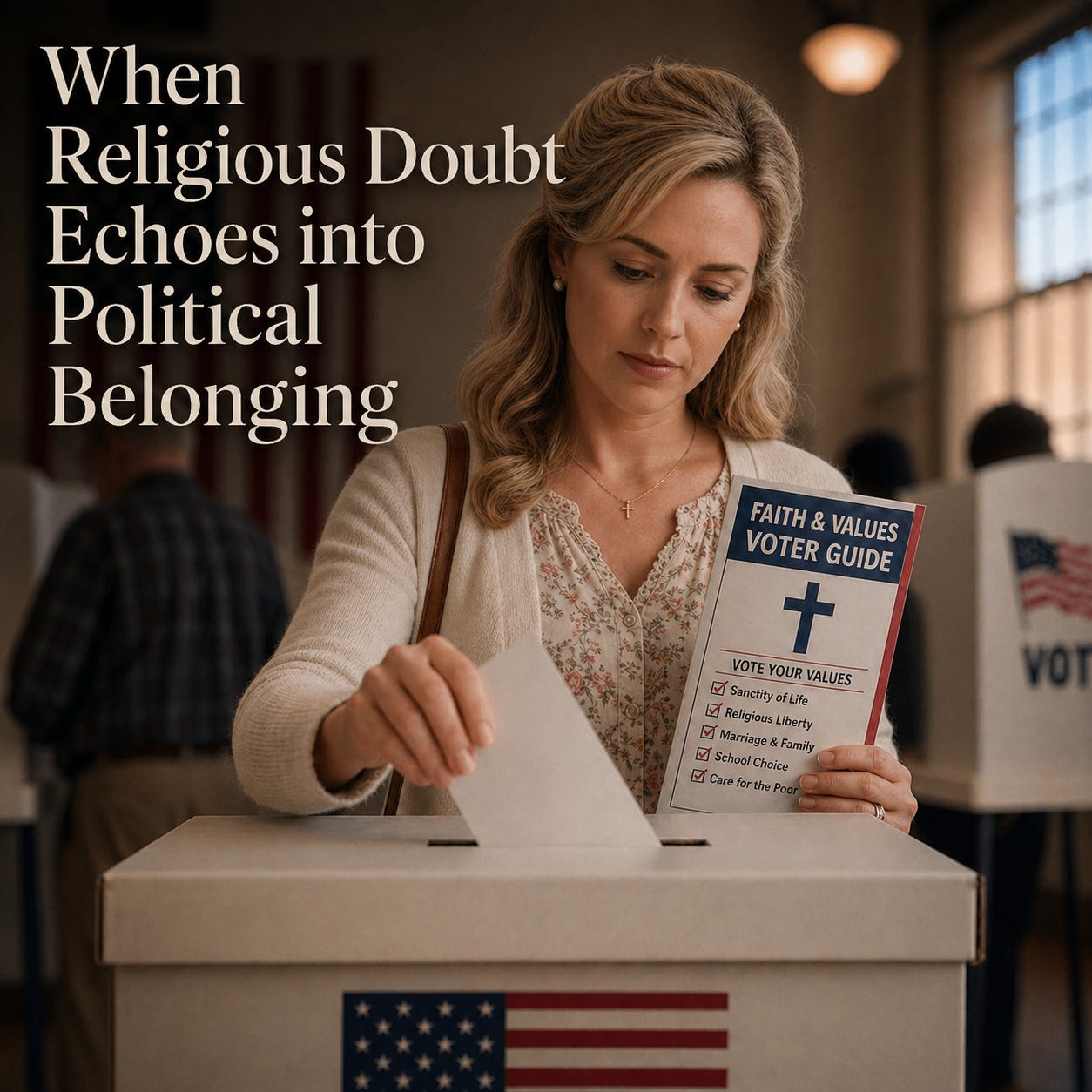
On Sunday, my pastor preached an incredible sermon about belief and unbelief, and I would encourage you to listen to him if you have the chance. I am still thinking about it, especially because in the middle of the sermon, he referenced a 2023 Barna study that looked at doubt and faith among both Christians and non-Christians. The study examines the things that cause people to question Christian beliefs. What was stuck out to me most in the study was that Barna found that no matter a person’s religious background, hypocrisy and human suffering were among the top reasons people selected for doubting Christian beliefs, regardless of religious background.
Of course people doubt. We are human beings with brains, grief, memory, disappointment, and access to Google at all hours of the day. Barna’s study seemed to codify something I have been trying to name for a while, not only about faith, but about what has happened in the political landscape of our country over the last eighteen months. We are watching people who had very firm beliefs about political loyalty, religious identity, patriotism, authority, and national purpose suddenly feel as if they are standing on shifting sand. The shift is not random. The doubt is not coming out of nowhere. It is coming from the same places Barna identified inside religious systems: suffering and hypocrisy.
I don’t think this is just about religion, and it is not just about politics. It is about the human reaction to high-demand institutions that make sweeping ideological declarations and ask us to organize our lives around them. Religion does that. National political movements do that. In this moment, those systems have not merely overlapped. They have borrowed each other’s language, symbols, fears, rituals, and organizational strategies. The church machine and the political machine are now speaking in the same register, and that is why this pattern transferred so cleanly.
I am someone who has lived through through an unhealthy religious system, and I know I’m not alone in this one. I know this is only from my experience, but I truly believ that once we have been hurt by a high-demand system, the survival strategies from that experience often come emerge in other areas of our lives. Many of us know what it feels like when a pastor uses the pulpit to hide his own sin, when leaders conflict with one another and demand control until the faith body splits, when loud power-hungry leaders stoke division in a church and call it discernment, or when a toxic church leadership begins shaping the whole spiritual atmosphere of a church in ways that leave us feeling uneasy. I am not saying church trauma and political disillusionment are the same thing, because they are not, but this is where the emotional echo begins.
In those moments, church leaders often position themselves as if they have a more direct line to God than the rest of us. As a result, the inference is that their authority on what God is demanding gets lifted higher than the body. Instead of our relationship with Jesus being direct, another layer gets placed between us and God, which is the very thing Christ came to abolish in the first place. Once that layer is in place, questioning leadership is interpreted like we are questioning God. If we name harm or sin in leadership, we are accused of causing division. If we begin to doubt what is happening in the church, people act as if we are doubting the presence and will of God Himself and perhaps we are struggling with our walk with the Lord. The saddest part for me is that if we leave a church body, the community often rewrites who we were. Suddenly, the people who served, loved, prayed, gave, taught children, cooked meals, cleaned up after events, and showed up for years are reframed as troublemakers, fake Christians, bitter people, or instruments of the enemy.
That is the part that leaves a bruise. The harm is not only what happened in leadership. but it is also the way the system demands that everyone else to reinterpret the wounded person so the institution does not have to repent. Toxic systems often collapse loyalty to leadership into loyalty to God. Once that happens, doubting the system feels like doubting the faith. Leaving the harm feels like leaving Jesus. Naming sin feels like attacking the church. Christ tore the veil. He did not die and rise again so we could rebuild smaller veils around charismatic leaders, church brands, political movements, or human institutions that cannot bear scrutiny.
This is why some of the rhetoric we hear in American politics now lands so hard for churched people, including me. How many times have we heard on Fox News or from conservative politicians, “If you do not like it, leave America.” Demanding agreement or leaving carries the same emotional structure many of us have heard in unhealthy churches. It is not an invitation to repair the community. It’s not even an invitation to be heard. It’s a loyalty test. It says belonging is conditional on submission. It says the person who names harm is the problem, not the harm itself.
Let’s take this even further, because in both politics and in the church, the reframing of people who don’t agree becomes even more dangerous. In the political world, people who question this current administration, criticize a policy, name cruelty, or refuse to excuse hypocrisy are not simply treated as citizens with a different view. They are verbally attacked. They called the “radical left” or “communists” or “the stup libs”. They are accused of hating America. They are framed as enemies of the state rather than members of the country. The underbelly of the argument is not merely, “You disagree with me and I don’t like what you are saying.” It is, “If you disagree with me, you are not really one of us.” In some versions, it goes even further. You are not just less patriotic, you’re tole that your aren’t truly American or maybe the enemy from within.
One of the clearest examples of this happening right now is Marjorie Taylor Greene, and let me say plainly that I have no love or admiration for Marjorie Taylor Greene. I think she is an opportunist and self-preservationist. And I certainly have not forgotten the way she treated Parkland High School shooting survivor David Hogg before she was in Congress, or the way she has made racist and demeaning comments toward Black colleagues in the House. She spent a lot of time before and during congress promoting Q-anon conspiracy theories including the antisemetic accusation that the Rothschild family were using Jewish space lasers to start willdfires in California. I am not suddenly trying to turn her into a misunderstood heroine because she found one moral line she was willing to name. However, look at what happened to her and tell me this does not reveal the machinery.
For years, Greene was one of Trump’s most loyal attack dogs. He benefited from her outrage, her conspiracy language, and her willingness to say the things that made the rest of us horrified, exhausted, and occasionally morbidly amused. Then the Epstein files became the issue, and Greene wanted them released. She aligned herself with survivors and pushed for transparency. Suddenly, the very traits Trump had praised, the volume, the defiance, the refusal to back down, were reframed as betrayal to the Republican party and to America in general. The minute she rubbed the president wrong, Trump called her a ranting lunatic, whacky, and Margorie Traitor Brown because she stood with Epstein’s victims, and she said that Epstein survivors were the patriots in that moment. Trump touted that she was not truly America First Maga, and that she was a RINO (Republican in name only). My favorite reframing for this example was when Trump said Greene only went "BAD" because she was "JILTED by the President of the United States". Can we all just let out a big sigh? This is the infamous MTG who is more MAGA than MAGA itself…until she wasn’t
That does not mean Greene’s past behavior disappears. It does not mean she is owed sainthood or a pat on the head for doing something humanly genuine. It means the system is showing us its rules. The loud person is brave until she questions the leader. The loyalist is a fighter until she asks for accountability. If Marjorie Taylor Greene, of all people, can be recast as the enemy the moment her loyalty shifts from Trump to Epstein survivors, then the message to everyone else is clear: nobody belongs because they are righteous, patriotic, Christian, conservative, useful, or brave. They belong only as long as they remain obedient.
However, what we are seeing in the United States right now is even more unstable because the religious symbolism has not stayed separate from the national symbolism. The religious rhetoric has not stayed separate from the political rhetoric. Many Americans, especially those of use entrenched in Evangelical Christianity, were told for years that this movement was about protecting faith, family, freedom, children, truth, and Biblical Values. Political loyalty and religious loyalty have been braided together until pulling on one strand starts to tug at the whole knot.
Listen, in the history of American politics, people have moved in and out of political parties whether the party flipped positions on an issue (this happens all the time), or politicians do something stupid or sketchy. We have always had politicians who made terrible personal choices, abused trust, lied, cheated, betrayed their families, embarrassed the office, or revealed that their public image was a lot shinier than their private character. Think about Gary Hart, who had been a Democratic frontrunner and was forced out of the 1988 presidential race after reporting exposed an extramarital affair. In the past, those were the kinds of revelations that made many Americans say, “No, I do not think so. You are not the politician for me.”
That is very different from what is happening right now.
If this were ordinary disappointment in a flawed politician, Donald Trump would have been politically finished the minute the Access Hollywood tape came out, or at the very least when the Stormy Daniels story became part of the national conversation. Less than two years ago that would have caused religious conservatives to say, “No, I do not think so. This man cannot be the moral standard-bearer for the country.” However, that is not what happened. Instead, many of the same religious voices who had spent decades preaching character, sexual purity, family values, and personal responsibility suddenly discovered a theology spacious enough to excuse almost anything, as long as the person doing it promised to protect their power.
That is why this is not just about a politician who failed. This is about what happens when the church, and especially parts of the evangelical church, helps wrap that politician in religious meaning until questioning him starts to feel like questioning God’s plan. We have heard this language for years, that Donald Trump is God’s flawed vessel, that God uses imperfect men, that he has been chosen for such a time as this, and that his enemies are not merely political opponents but enemies of what God is doing in America.
If you watched the White House Easter prayer event, you could see this theology of political loyalty playing out in real time. Trump stood before religious leaders and spoke in the language he often uses, naming enemies, defending his administration, presenting criticism as persecution, and placing his own controversies inside a room full of sacred symbols and people of faith.
Then Paula White took the stage, and that is the part that should make the hair on the back of our necks stand up. White did not merely pray for the president, which would have been one thing. However, she compared the pattern of Trump’s life to the pattern of Christ’s suffering and resurrection. She said no one had paid the price like Trump had paid the price. She said he had been betrayed, arrested, and falsely accused, and then described that as a “familiar pattern” shown by “our Lord and Savior.” Then she moved from the resurrection of Jesus to the political restoration of Donald Trump, telling him that because Christ rose, he rose up, and because Christ was victorious, he would be victorious in all he put his hand to. That is not just prayer. That is religious authorization. That is the language of resurrection being placed over a political leader’s survival, power, and agenda.
This is why the doubt becomes so hard Christians in the center who are trying to make sense of what they are seeing in the politics and in their churches at the same time. The question is no longer only, “Did this politician fail?” The deeper question becomes, “Why am I being asked to call this failure faithfulness? Why are religious leaders using the language of Jesus’ suffering, death, and resurrection to sanctify a man’s political comeback?” People are not only questioning Trump. They are questioning the religious machinery that told them defending him was part of defending God, faith, family, and America.
That brings us right back to Barna’s study. The two big pressure points were hypocrisy and human suffering, and right now the Epstein files, Iran, and the economy are pressing on those same wounds.
The Epstein files continue to hit the hypocrisy nerve. This was supposed to be the movement that exposed corruption, protected children, named the predators, and pulled back the curtain on elite power. However, when the people who promised transparency become evasive, selective, or defensive, it starts to feel less like justice and more like another cover story.
Iran hits both the hypocrisy nerve and the suffering nerve. This was supposed to be the no-new-wars movement, the alternative to endless foreign intervention. However, when the rhetoric turns back toward existential-threat language, when another country is framed as the next great danger to civilization, and when military escalation becomes part of the conversation again, people are left wondering what happened to the promises. War is not an abstraction. War means death, fear, price shocks, and ordinary people once again being told to absorb the consequences of decisions made far above their heads.
Then there is the economy…sigh…which may be the most personal pressure point of all because it follows people into the grocery store, the rent payment, the insurance bill, the medical bill, the job search, and the panic of wondering how much longer they can keep making the math work. People can tolerate a lot of political noise when they believe their family is going to be okay. However, when the promises of relief do not become relief, doubt stops being abstract.
Together, these three things create a crisis with no easy off-ramp. There is no clean place for people to rest their trust. There is no obvious sense that truth is winning, justice is coming, or tomorrow will be better if everyone just stays loyal a little longer.
The same inward doubt we feel during religious trauma is now reverberating as people are doubting the administration. Looking at the truth of this requires doubting ourselves and our own discernment. We sit there wondering whether we misread the movement, the people in charge, or our own place in the country. In essence, it causes us to face some pretty scary questions, “If I speak against what my political and religious leaders are saying, where do I belong? If I name this as wrong, what does that make me? If I cannot keep defending this, am I still part of my community, my church, my family, my country?”
That is the cruelest part of any high-demand system. It does not only demand loyalty to the people in charge. It makes people feel as if questioning the system means losing themselves.
However, that is the lie.
The United States is not one man. The church is not one pastor. Faith is not one institution. Patriotism is not one party. Belonging is not supposed to be controlled by the loudest person with the microphone. We are the United States of America, just like we are the church. The people are not disposable accessories to the institution. The people are the reason the institution exists.
And when the people begin to doubt, maybe that is not always evidence that they are losing faith. Maybe sometimes it is evidence that their conscience is waking back up.